Garage & Shop Floor Slabs in Wichita, KS
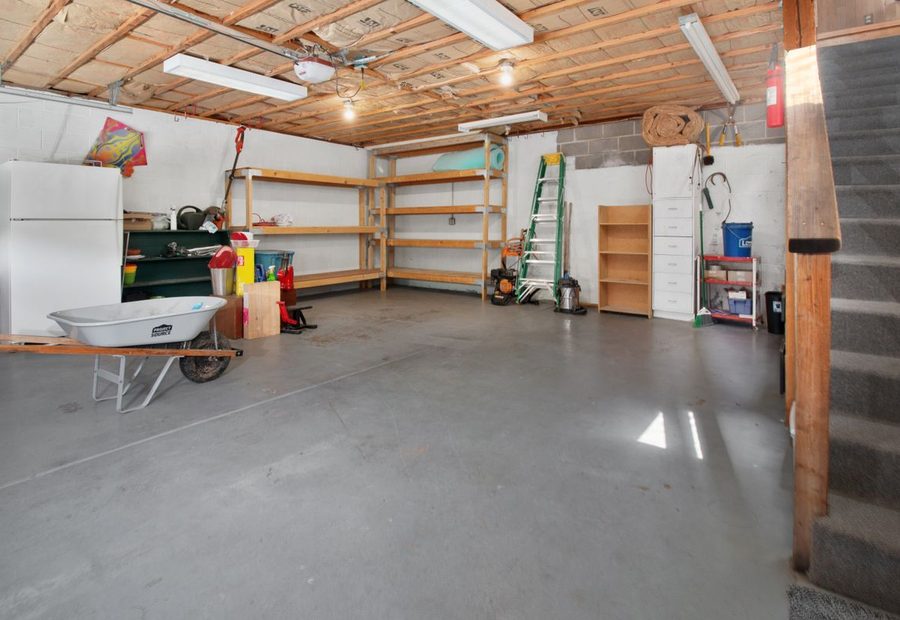
Wichita Concrete Pros replaces garage and shop floor slabs for properties across Wichita and Sedgwick County, Kansas. We are a licensed and insured concrete contractor. This service covers attached garage floors, detached shop slabs, and outbuilding floors that have cracked, heaved, or sunk on the clay under them.
A new floor is 4000 PSI air-entrained concrete over a compacted crushed-stone base, poured on a vapor barrier with thickened edges and control joints cut into the surface. The vapor barrier keeps ground moisture out of the slab, and the thickened edges carry the wall and wheel loads without cracking. A slab dropped on unprepped fill has none of that support, which is why it breaks apart under a vehicle.
The Base Under a Garage Floor
A garage floor takes point loads a patio never sees: a truck axle, a jack stand, a loaded shelf. All of it presses through the slab into the ground. We compact the subgrade, lay four to six inches of crushed stone, and compact that too, so the load has something solid to push against. On Wichita clay, the base is what keeps the floor flat.
Vapor Barrier and Thickened Edges
Before the pour we roll a vapor barrier over the base to stop damp from wicking up through the concrete. Then we thicken the slab around the perimeter and at interior load points so the edges are stronger than the field. Those two steps are the difference between a shop floor you can coat and store on and one that sweats and cracks at the walls.
Control Joints and Crack Control
A wide interior slab wants to crack as it cures and as the ground moves. We cut control joints on a grid so it cracks along those lines instead of across the floor. The joints also give a clean pattern if you seal or coat the slab later. Concrete will crack; the joints decide where.
Isolated From the Walls
The floor and the foundation walls move at different rates. We set an isolation joint where the slab meets the walls and any step down into the garage, so the floor can move without dragging on the walls. The walls stay; the floor is free to shift a hair without cracking against them.
What It Costs
Garage and shop floor work in Wichita depends on the square footage, the thickness, and how much old slab and fill has to come out. A single-car floor on good ground is a smaller job than a full shop slab with a base rebuild. Every floor gets a free written estimate first.
Garage floor cracked, heaved, or sunk in a corner? (316) 555-0148 gets you a real person and a free estimate anywhere in Sedgwick County.
Why is my garage floor cracking and heaving?
A garage slab poured on loose fill or bare clay has nothing stable under it. Wichita clay swells and shrinks with moisture, and without a compacted stone base and a vapor barrier the slab lifts, cracks, and lets damp up through the surface. Rebuilding the base and pouring a jointed slab takes that movement out.
Does a garage floor need a vapor barrier?
Yes. A vapor barrier is a sheet laid over the base before the pour that blocks ground moisture from wicking up through the slab. Without it, damp comes through the concrete, sweats under stored items, and works against any coating you put down later. It is cheap insurance poured into the job.
What are thickened edges on a garage slab?
The slab is poured deeper around its perimeter and under any interior load point, so the edges that carry the walls and the wheel loads are stronger than the field of the floor. This keeps the edges from cracking where the weight concentrates. We form them into the pour as part of the slab.
Can you replace just the garage floor without touching the walls?
In most cases, yes. We break out and haul off the old slab, rebuild and compact the base inside the footprint, and pour a new floor up to the existing walls with an isolation joint between them. The walls and footing stay; the floor starts over on solid ground.